
BLOG
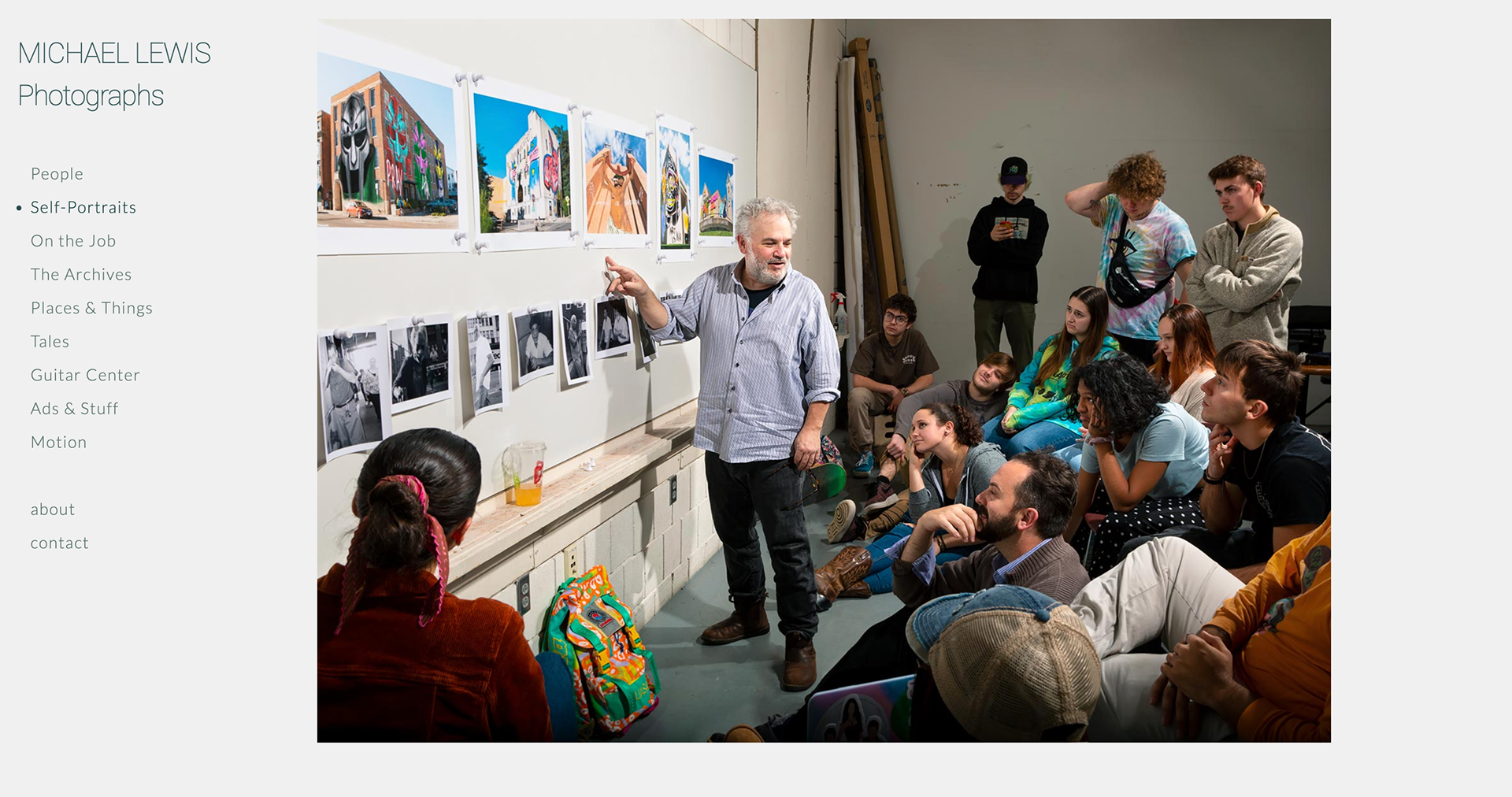
Screenshot of Michael Lewis's Portfolio, displaying a Self-Portrait
Honoring Professor Michael Lewis, Photographer
September 23, 2026
I had the pleasure of learning from Michael Lewis, Assistant Professor of Photography at Ithaca College, in three classes while completing my photography minor in the Media Arts, Sciences, and Studies Department. I learned he died on Sept. 19, 2026. Online, he may be remembered as the photographer who captured the viral Anthony Mackie "Son" meme. For fans of an endless list of artists, comedians, actors, musicians, and other celebrities may recognize his images created for Variety, the New York Times, However, among my friends, classmates, and colleagues, he is remembered as so much more. Here is how I remember Michael Lewis.
When I registered for Professor Lewis’s Advanced Digital Photography course, I told everyone I knew how anxious I was. This fear of mine was no doubt derived from Michael's absolutely striking images, both in his commercial portfolios and personal bodies of work. I didn’t know what to expect from this professor who had not only created such visually rich images of some of the most recognizable figures in entertainment, but also then, notably, dared to insert himself into their portraits to create his memorable On the Job series. Not to mention the courage he had to make an extensive series of self-portraits at critical times in his life. Before I began this course with Professor Lewis, I felt like declaring my photography minor was an excuse to have registration access for one more class before dropping the discipline in my course of study altogether. I told my parents, my family, my new boyfriend, my friends, and probably even other professors. I was scared. Intimidated.
My blind intimidation turned into great respect once I saw Michael Lewis in action. By in action, I do not mean while shooting photographs, although I am now thankful for the many opportunities I received to see him work his magic in-camera in the lighting studio, whether it be performing as a model, holding a bounce card for the first time, or listening to him warn my class not to screw up the retractable backdrops. Michael Lewis in action, as me and my classmates remember him, meant Professor Lewis’s spot-on critiques, his unique humor, and the tips we use every time we edit a digital image to this day. We learned to always rename our files, a warning I can hear in Michael’s voice not only every time I proofread this reflection, but also every single time I manage my files. Especially if I forgot to name them and find myself searching for a specific image. It is in this situation that I tell myself, “Professor Lewis taught me better than this.” How apparent it is now, searching for images where I might have captured his likeness during some demo or class session, that I still had so much left to learn from him, even when I knew the lesson he taught by heart.
Under Professor Lewis’s guidance in Advanced Digital Photography, I truly found my footing in image making. I think I might have been scared originally that my work was not going to make the mark, or had a preconceived notion that he might be somewhat stuck-up because of his portfolio. Each assignment in this class proved to me just how wrong I was to harbor these fears. I learned that making the mark in his course was not solely about the content I produced, but also about the product I could only achieve through responding to his often concise, clear-cut comments and learning to interpret his sometimes offbeat suggestions. Getting out of my comfort zone by learning from a different style of critique partner in Professor Lewis was so valuable as I learned to adapt to various sources of feedback in my practice. I likewise learned that Michael was very far from stuck-up. He delighted in sharing down-to-earth stories of his family and his personal history just as much as the most insane client-based tales he’d tell the class, often accompanied by practical warnings that were just as humble as they were impressive.
In retrospect, I understand my initial feelings of intimidation related to my professor. People with work like Michael Lewis are not so often regular figures in a student’s life. People with accomplishments like Michael Lewis are not so often friendly and helpful to young artists. I had no idea that I would have the chance to become so conversational and connected with so rare an individual. I was so lucky to be able to develop my first body of self-portraiture under this prolific self-portraitist and then finish out my undergraduate studies with a self-portrait-based thesis project completed under his guidance. As an artist focusing intensely on my self-image through self-portraiture in my work, I took for granted just how important of an influence Michael Lewis was on my work. The example he set in self-portraiture was so valuable, but even more so, perhaps, was the way his vocal support of my projects literally improved my self-esteem, helping me identify as an artist and a photographer. Writing artist statements for the first time in his class while considering aspirational goals for my work suddenly made me think that I really did want that photography minor after all. Learning that he cared about the work I completed in my thesis on a personal level as the parent of a child who might soon face challenges I addressed in my bodies of work made me feel motivated and purposeful in my practice. If I learned that he liked work I completed, I told everyone I knew and cared about.
I constantly recall facts about Michael Lewis’s photo shoots whenever I am reminded of certain celebrities. Seeing a headline or hearing a song on the radio finds him popping into my mind. Certain songs also remind me of the music he loved to share with students during his classes while we worked on our images and showed him to receive feedback. Over the years, I have took pride in sharing these stories with the same people I previously told about how I was scared to study under Professor Lewis. The last class I attended on Ithaca’s campus was his class, my thesis photography critique, and I will never forget how I stayed up all night to prepare my work for it after (maybe) biting off more than I could chew. I still wanted to impress him, even years after showing him my work for the first time. Even though this desire began as something more anxious and clueless, it grew as I learned that his honest opinion, his support, and his time to give feedback meant so much. So much, in fact, that I still want to impress him. He told me to keep in touch just one week before his passing. I imagined so much more time. I thought I might see him within the month. I can't believe it.
Reflecting on my experience with Michael, I feel solace in knowing I’m not the only student who has had the experience I describe in this writing. So many students have had the chance to find mentorship and support from Professor Lewis, and as I have seen more and more reflections emerging online and in conversations with other students of Lewis's, I have realized that our stories all share similar emotional arcs. I saw my friend Maggie go from afraid of using color in her photography to using it in such a striking way in her work, no doubt inspired by Michael’s insane eye for color and his comprehensive instruction on color grading. This is just one example of many. Countless digital photographs that come from Ithaca College Photography students display the results of all the tips and tricks in digital editing that Michael shared with us, and to recognize the evidence of this transfer of knowledge in someone’s work will now forever make me emotional. Similarly, a whole program’s worth of students learned to refer to a distinctive visual style as “So Michael Lewis” and will continue to think and repeat this phrase for the rest of their lives when describing work they analyze and create. Not only Professor Lewis’s students, however, know his work and impact so well. All their friends who served as the models and lighting assistants for shoots he would critique, and who became tourists of the digital labs and lighting studio he so often commanded the attention of, and even just the casual viewer of his work in exhibition, whether in his gallery show or on slides through a classroom window, will remember Michael Lewis, his calling as a professor, and his images.
Reflecting on my experience with Michael, I feel solace in knowing I’m not the only student who has had the experience I describe in this writing. So many students have had the chance to find mentorship and support from Professor Lewis, and as I have seen more and more reflections emerging online and in conversations with other students of Lewis's, I have realized that our stories all share similar emotional arcs. I saw my friend Maggie go from afraid of using color in her photography to using it in such a striking way in her work, no doubt inspired by Michael’s insane eye for color and his comprehensive instruction on color grading. This is just one example of many. Countless digital photographs that come from Ithaca College Photography students display the results of all the tips and tricks in digital editing that Michael shared with us, and to recognize the evidence of this transfer of knowledge in someone’s work will now forever make me emotional. Similarly, a whole program’s worth of students learned to refer to a distinctive visual style as “So Michael Lewis” and will continue to think and repeat this phrase for the rest of their lives when describing work they analyze and create. Not only Professor Lewis’s students, however, know his work and impact so well. All their friends who served as the models and lighting assistants for shoots he would critique, and who became tourists of the digital labs and lighting studio he so often commanded the attention of, and even just the casual viewer of his work in exhibition, whether in his gallery show or on slides through a classroom window, will remember Michael Lewis, his calling as a professor, and his images.
Thank you, Professor Lewis, for all your support.
I hope this counts as keeping in touch.
Caleb Cackowski